

Table of Contents
The GATE exam is more than an entrance exam for postgraduate engineering programmes. A valid GATE score can provide access to M.Tech and M.E. admissions, PSU recruitment opportunities, research programmes, fellowships and other career options.
The opportunities available after GATE depend on your GATE paper, score, academic background, institute and the eligibility criteria of the organisation or programme.
This guide explains the major benefits of GATE exam, career opportunities after GATE, PSU jobs, higher studies, research options and branch-wise opportunities.
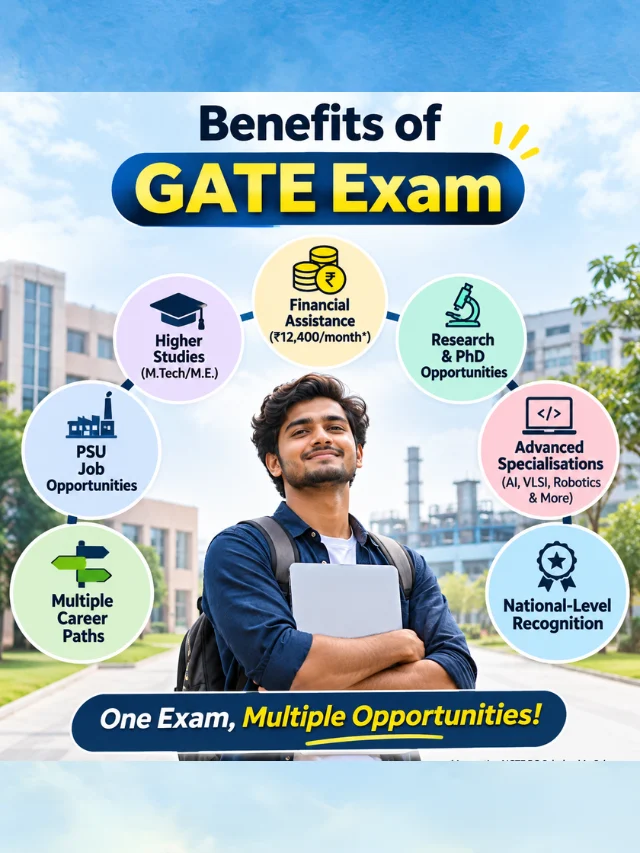
Benefits of GATE Exam: Quick Overview
Some of the major benefits of qualifying GATE include:
- PSU job opportunities: Several PSUs use GATE scores as part of their recruitment process.
- M.Tech and M.E. admission: GATE scores are accepted for postgraduate admissions at IITs, NITs, IISc and other institutions.
- Financial assistance: Eligible postgraduate students may receive scholarships, stipends or assistantships as per the applicable scheme.
- Research opportunities: GATE can be useful for admission to research-oriented postgraduate and PhD programmes.
- Fellowship opportunities: Eligible candidates can apply for certain research fellowships and programmes.
- Multiple career paths: Candidates can choose between jobs, higher education, research and specialisation after GATE.
- National-level recognition: GATE provides a standardised assessment of engineering and science aptitude used by several institutions and organisations.
1. PSU and Government Job Opportunities Through GATE
One of the major benefits of GATE exam is the opportunity to apply for recruitment in Public Sector Undertakings (PSUs).
Several PSUs use GATE scores to shortlist candidates for positions such as Engineer, Executive Trainee and Management Trainee, depending on the organisation and recruitment cycle.
Some organisations that have recruited through GATE in different years include:
- ONGC
- NTPC
- IOCL
- BHEL
- GAIL
- Power Grid
- NPCIL
- SAIL
- BEL
- HPCL
- BPCL
- HAL
- Coal India
- DRDO
- RITES
- ECIL
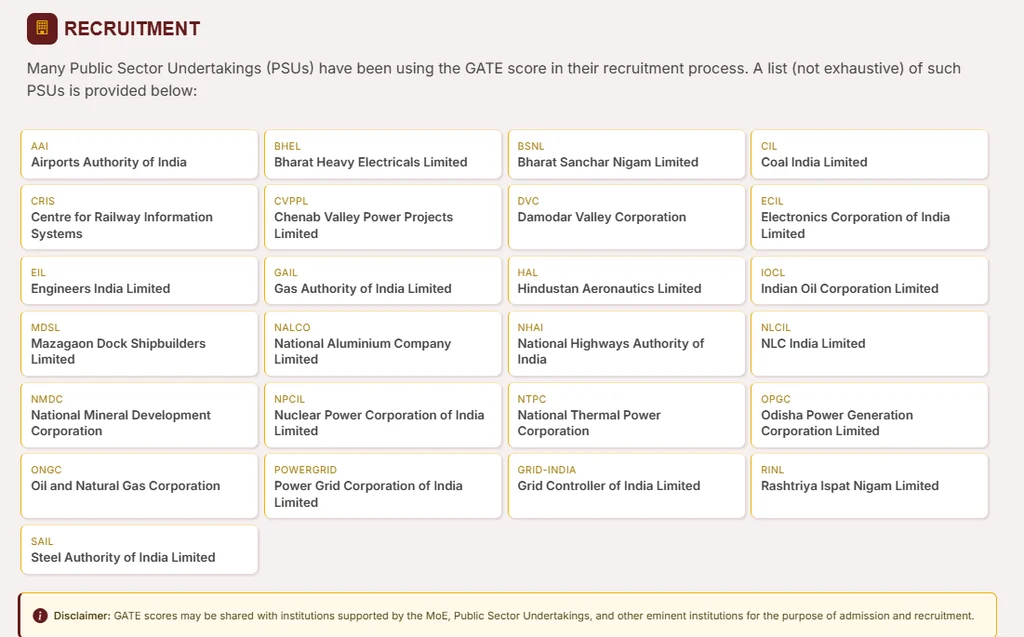
The list is not fixed. PSU recruitment through GATE depends on the organisation’s requirements and the eligibility criteria mentioned in its latest recruitment notification. Candidates should also review the GATE eligibility criteria before considering specific recruitment opportunities.
How Does PSU Recruitment Through GATE Work?
The recruitment process generally follows these steps:
- The PSU releases a recruitment notification mentioning the eligible GATE paper and year.
- Candidates submit an application using their GATE details.
- The organisation shortlists candidates based on its prescribed criteria.
- Shortlisted candidates may have to appear for an interview, group discussion, assessment or other selection stages.
- Final selection is made according to the PSU’s recruitment rules.
Does GATE Guarantee a PSU Job?
No.
A GATE score can make a candidate eligible for certain PSU recruitment opportunities, but final selection depends on the individual PSU’s eligibility criteria, cutoff, selection process and available vacancies. Candidates can refer to previous GATE cutoff trends to understand how qualifying marks and admission or recruitment cutoffs differ.
2. Higher Studies at IITs, NITs and IISc
Another major benefit of GATE exam is access to postgraduate education.
A valid GATE score is used for admission to eligible programmes at institutions including:
- IITs
- NITs
- IISc
- IIITs
- Other participating institutes
Candidates interested in postgraduate admissions can explore the list of top GATE colleges in India to understand the available institutes and higher-study options.
Depending on the GATE paper and academic background, candidates can pursue programmes in areas such as:
- Computer Science and Engineering
- Artificial Intelligence and Data Science
- VLSI and Electronics
- Communication Engineering
- Mechanical Engineering
- Electrical Engineering
- Civil Engineering
- Chemical Engineering
- Aerospace Engineering
- Biotechnology
- Energy and Environmental Engineering
Admission requirements and GATE cutoffs vary by institute and programme.
3. GATE Stipend and Financial Assistance
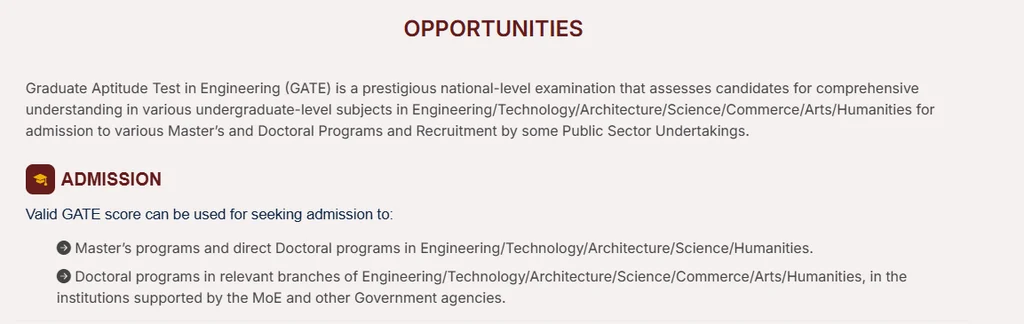
For eligible students, GATE can also provide access to financial assistance during postgraduate studies.
Eligible GATE-qualified students admitted to applicable full-time postgraduate programmes may receive financial assistance under the relevant scholarship or assistantship scheme.
For example, the AICTE PG Scholarship Scheme provides ₹12,400 per month to eligible students under its applicable rules. Candidates can understand the eligibility, amount and conditions through this detailed guide on GATE stipend and financial assistance.
However, qualifying GATE alone does not guarantee a stipend. Students must satisfy the scholarship conditions and complete the required institutional verification.
4. Research and PhD Opportunities
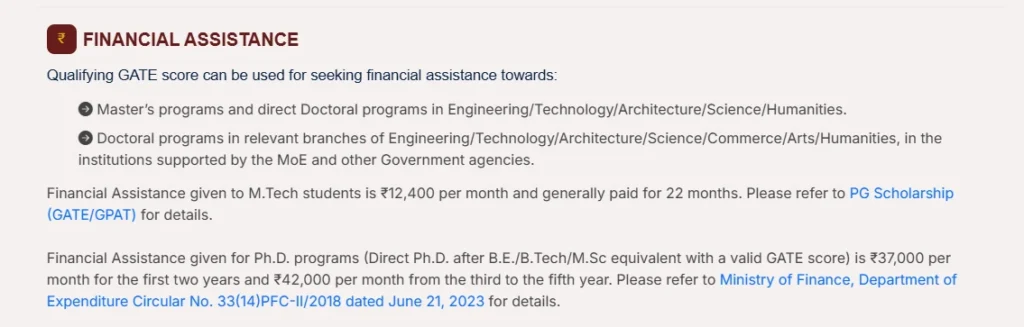
GATE can also support candidates who want to pursue a research or academic career.
A GATE score may be considered for admission or eligibility in certain:
- PhD programmes
- Research programmes
- Institute-level research opportunities
- Fellowship programmes
- R&D positions
Eligibility varies considerably between institutions and programmes. Candidates should check the specific admission notification for GATE score requirements.
GATE and PMRF
The Prime Minister’s Research Fellowship (PMRF) is a separate research fellowship programme. GATE may form part of the eligibility criteria for certain applicants, along with academic performance, research potential and other prescribed requirements.
Therefore, GATE should be viewed as one component of the eligibility route, rather than an automatic route to PMRF.
5. Career Opportunities After GATE
The opportunities after GATE exam are not limited to PSU recruitment or M.Tech admission.
Candidates can choose different paths based on their career goals:
| Career Path | What GATE Can Help With |
| PSU Jobs | Eligibility for recruitment processes that accept GATE scores |
| M.Tech/M.E. | Admission to postgraduate programmes |
| Research | Entry to research-oriented programmes and opportunities |
| PhD | Eligibility for selected PhD programmes |
| Specialisation | Advanced study in technical and interdisciplinary fields |
| Teaching/Academia | Higher qualifications for academic careers |
| R&D | Technical and research-oriented career opportunities |
6. Better Specialisation Through M.Tech
GATE allows engineering and science graduates to pursue advanced specialisations that may not have been part of their undergraduate curriculum.
For example, a candidate can use GATE to pursue areas such as:
- AI and Machine Learning
- Data Science
- VLSI Design
- Embedded Systems
- Power Systems
- Structural Engineering
- Thermal Engineering
- Robotics
- Renewable Energy
- Biotechnology
Candidates should review the relevant GATE syllabus to understand the subjects and topics covered in their selected paper before choosing a specialisation.
An M.Tech can help candidates develop specialised technical knowledge and open opportunities in R&D, academia and specialised engineering roles.
7. Branch-Wise Benefits of GATE Exam
The benefits of GATE vary by branch because PSU recruitment, postgraduate programmes and research opportunities have different eligibility requirements.
| GATE Branch | Major Opportunities |
| CSE/IT | M.Tech in CSE, AI, Data Science and related fields; selected PSU IT roles; research opportunities |
| ECE | VLSI, Communication, Embedded Systems; selected PSU and R&D opportunities |
| Mechanical | Design, Thermal, Manufacturing; opportunities in selected PSUs and higher studies |
| Electrical | Power Systems, Control, Electrical Engineering; selected PSU and research opportunities |
| Civil | Structural, Geotechnical, Transportation; selected PSU and higher-study opportunities |
| Chemical | Chemical, Process and related specialisations; selected PSU opportunities |
| Architecture | M.Arch and related postgraduate opportunities; selected recruitment opportunities |
| Life Sciences | Higher studies, biotechnology and research-oriented programmes |
| Mathematics/Science Papers | Higher studies, research and interdisciplinary programmes, subject to institute-specific eligibility |
The GATE exam pattern also helps candidates understand the question types, marking scheme and paper structure for their selected branch.
Important: PSU and institute eligibility can change from one recruitment or admission cycle to another. Always check the latest notification for the required GATE paper, qualifying degree and other conditions.
8. National-Level Recognition
GATE is a national-level examination conducted jointly by the IITs and IISc on behalf of the National Coordination Board, GATE.
A GATE score is recognised by participating higher-education institutions and is also used by several organisations for recruitment and other opportunities.
Candidates planning to appear in the upcoming examination can check the GATE 2027 exam details, eligibility and important updates to understand the latest examination cycle.
This makes GATE useful for candidates looking to keep multiple career and education options open after graduation.
9. What Can You Do After Clearing GATE?
After qualifying GATE, candidates can consider several options:
Pursue M.Tech or M.E.
Choose a postgraduate programme at an IIT, NIT, IISc or another participating institution based on your score and eligibility.
Apply for PSU Recruitment
Look for PSU notifications that accept the relevant GATE paper and score.
Pursue Research
Explore research-oriented postgraduate, PhD and fellowship opportunities.
Build a Technical Specialisation
Use postgraduate education to move into an emerging or specialised area such as AI, VLSI, robotics, power systems or data science.
Prepare for Other Competitive Opportunities
A GATE preparation journey can also strengthen fundamentals in core engineering and science subjects, which can be useful for other technical examinations.
Candidates preparing for the next GATE attempt can practise using GATE previous year question papers to understand question trends and assess their subject knowledge.
A structured GATE preparation strategy can also help candidates plan their study schedule, revision and mock-test practice.
Candidates appearing in the upcoming examination should also track the GATE exam date and important events to plan their preparation timeline. After submitting an application, they should check the applicable GATE correction window instructions if any application details need rectification.
Is GATE Worth It?
GATE can be valuable for candidates who want to pursue higher studies, PSU recruitment, research or technical specialisation.
However, the value of GATE depends on the candidate’s objective. A student targeting M.Tech admission may have different priorities from someone targeting PSU recruitment or research.
Before preparing, consider:
- Your preferred career path
- Target institutes or PSUs
- GATE paper and eligibility
- Expected preparation time
- Admission and recruitment requirements
- Alternative career options
Important Points About GATE Benefits
- GATE qualification does not guarantee a PSU job.
- PSU recruitment criteria vary by organisation and recruitment year.
- A valid GATE score can be used for eligible postgraduate admissions.
- Stipend or assistantship depends on the applicable scheme and institute.
- Research and fellowship opportunities have separate eligibility requirements.
- GATE benefits vary according to your paper, score, academic background and career goal.
- Always check the latest admission or recruitment notification before applying.





[…] Check: Benefits of GATE Exam […]