
Table of Contents
The CAT Entrance Exam 2026, or Common Admission Test, is the national-level management entrance examination used by the Indian Institutes of Management (IIMs) for admission to their postgraduate management programmes. CAT scores are also accepted by a range of other management institutes in India.
For 2026, the supplied competitor sources identify IIM Indore as the conducting institute and 29 November 2026 as the CAT exam date. The examination is described as a computer-based test with three sections: Verbal Ability and Reading Comprehension (VARC), Data Interpretation and Logical Reasoning (DILR), and Quantitative Aptitude (QA).
CAT Entrance Exam 2026: Quick Details
| Particular | CAT 2026 Details |
| Exam name | Common Admission Test |
| Common name | CAT |
| Conducting IIM | IIM Indore |
| Exam date | November 29, 2026 |
| Exam mode | Computer-based test |
| Duration | 120 minutes |
| Sections | VARC, DILR and QA |
| Sectional time | 40 minutes per section |
| Questions | 68, according to the supplied 2026 CAT details |
| Question types | MCQ and TITA |
| Correct answer | +3 marks |
| Incorrect MCQ | -1 mark |
| TITA negative marking | No |
| Exam frequency | Once a year |
| Official website | www.iimcat.ac.in |
Details ncluding some registration and result dates. Candidates should therefore use the official CAT notification and website for the final schedule before submitting an application.
What Is the CAT Entrance Exam?
The Common Admission Test (CAT) is an annual entrance examination for postgraduate management admissions. The IIMs use CAT scores as part of their admission process, while other business schools can set their own CAT-score requirements and selection procedures.
CAT tests candidates in three areas:
- Verbal Ability and Reading Comprehension (VARC)
- Data Interpretation and Logical Reasoning (DILR)
- Quantitative Aptitude (QA)
The examination moved to an online format in 2009. The sources also report that CAT attracts several lakh registrations in recent years, making it one of the most widely attempted management entrance examinations in India.
A CAT score does not by itself guarantee admission to an IIM. Each institute can apply its own shortlisting and final-selection criteria. Academic performance, work experience, interview performance and other profile factors can form part of that process.
CAT 2026 Exam Dates
The supplied 2026 CAT information gives the following schedule:
| Event | Date |
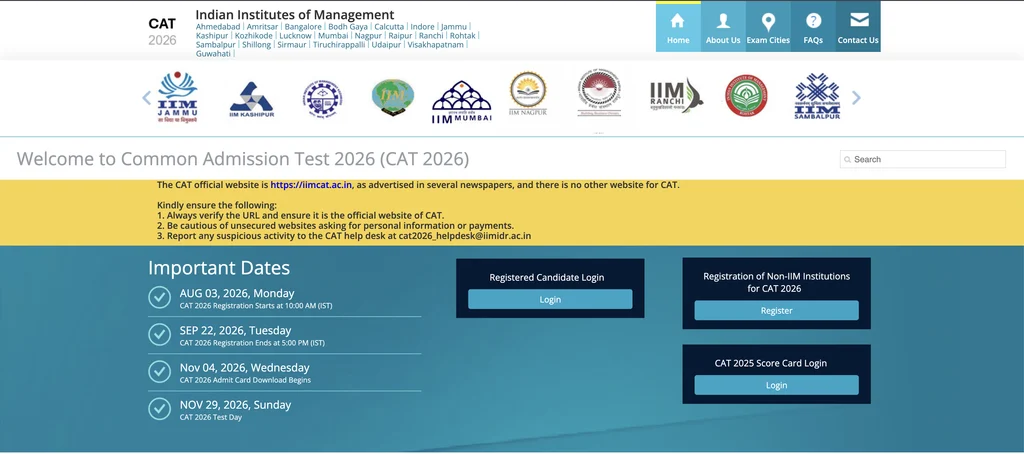
| CAT 2026 notification | July 26, 2026 |
| Registration starts | August 3, 2026 |
| Last date to register | September 15, 2026 |
| Admit card release | November 4, 2026 |
| CAT 2026 exam | November 29, 2026 |
| Answer key | December 2026, tentative |
| Result | December 2026, tentative in one source |
The sources do not agree on the result date. One source places the result in the third week of December 2026, while another gives January 2027. Because the result date is time-sensitive, candidates should check the official CAT portal for the final announcement.
Who Is Eligible for the CAT Entrance Exam?
The supplied CAT eligibility information states that candidates must meet the following academic requirements:
Educational qualification
A candidate should hold a bachelor’s degree with at least 50% marks or equivalent CGPA. The minimum requirement is 45% for SC, ST and PwD candidates.
Final-year students
Candidates appearing in the final year of their bachelor’s degree can apply, subject to the conditions specified in the CAT notification.
Professional qualifications
The supplied material also lists professional degree holders such as CA, CS, CMA and Fellows of the Institute of Actuaries of India among eligible applicants.
Age limit
There is no upper age limit mentioned in the supplied CAT eligibility information.
Number of attempts
State that CAT does not impose a limit on the number of attempts.
CAT 2026 Registration
CAT registration is conducted online. Candidates need to create an account, enter personal and academic information, upload the required documents, select programme and test-city preferences, and pay the application fee.
How to Register for CAT 2026
- Visit the official CAT website.
- Select the option for new registration.
- Enter your name, date of birth, email address and mobile number.
- Create and verify your CAT account.
- Log in using the credentials provided during registration.
- Enter personal, academic and communication details.
- Add Class 10, Class 12 and graduation information.
- Enter work-experience and professional-qualification details where applicable.
- Upload the required photograph, signature and certificates.
- Select IIM programmes and test-city preferences.
- Review the complete application.
- Pay the application fee.
- Submit the form and retain the confirmation details.
Candidates can select up to five test-city preferences for CAT 2026.
Documents Required for CAT Registration
Keep the relevant documents ready before beginning the application:
- Recent passport-size photograph
- Scanned signature
- Class 10 details
- Class 12 or diploma details
- Graduation marks/details
- Category certificate, where applicable
- PwD certificate, where applicable
- Professional qualification details, where applicable
- Final-year certificate, where applicable
The exact file format, size and document requirements should be checked in the current CAT application instructions.
CAT Application Fee
The supplied 2026 sources state the following fee structure:
| Category | Application fee |
| General, EWS and NC-OBC | ₹2,700 |
| SC, ST and PwD | ₹1,350 |
One of the competitor sources lists older expected figures, so the current CAT application portal should be treated as the final reference for the fee payable at registration.
CAT 2026 Exam Pattern
The CAT Entrance Exam is divided into three separately timed sections. Candidates cannot freely move between sections during the examination.
| Section | Questions | Time |
| VARC | 24 | 40 minutes |
| DILR | 22 | 40 minutes |
| QA | 22 | 40 minutes |
| Total | 68 | 120 minutes |
Marking scheme of +3 for a correct answer and -1 for an incorrect MCQ. TITA questions do not carry negative marking according to the supplied material.
What Are TITA Questions?
TITA means Type In The Answer. Instead of selecting an option, the candidate enters the answer into the test interface.
This makes question selection important because a candidate cannot rely on option elimination in a TITA question. State that incorrect TITA answers do not attract negative marks.
Sectional Time Limit
Each section receives 40 minutes. When that period ends, the test moves to the next section. A candidate cannot return to the previous section after the sectional timer expires.
CAT 2026 Syllabus
IIM does not publish a chapter-by-chapter CAT syllabus in the same way as many school or university examinations. The topic lists below are therefore based on the areas identified in the supplied competitor material and previous CAT question patterns.
VARC Syllabus
VARC contains Reading Comprehension and Verbal Ability questions.
Common areas include:
- Reading Comprehension
- Para Jumbles
- Para Summary
- Odd Sentence Out
- Para Completion
- Verbal reasoning
- Inference-based questions
Reading Comprehension forms a substantial part of VARC. The supplied competitor analysis describes RC as accounting for roughly 16–18 questions in recent paper patterns.
Preparation should therefore include regular reading and timed RC practice. Candidates need to identify the central argument, supporting information, author’s tone and the distinction between an inference and a statement that the passage does not support.
DILR Syllabus
DILR combines Data Interpretation with Logical Reasoning.
Common question areas include:
- Tables
- Bar graphs
- Line graphs
- Pie charts
- Caselets
- Data analysis
- Data sufficiency
- Arrangements
- Seating arrangements
- Grouping
- Routes and networks
- Puzzles
- Series
- Venn diagrams
- Coding-decoding
- Binary logic
DILR is generally presented through sets rather than isolated questions. A candidate may need to understand the conditions of one set before answering several questions based on it.
Quantitative Aptitude Syllabus
The major QA areas listed:
Arithmetic
- Percentages
- Profit and Loss
- Ratio and Proportion
- Averages
- Time and Work
- Time, Speed and Distance
- Simple and Compound Interest
- Partnership
Algebra
- Linear equations
- Quadratic equations
- Inequalities
- Functions
- Progressions
- Surds and Indices
- Logarithms
- Binomial Theorem
Geometry and Mensuration
- Lines and angles
- Triangles
- Circles
- Mensuration
- Coordinate and 3D geometry
Number System
- Factors
- Multiples
- HCF
- LCM
- Divisibility
- Square roots and cube roots
Modern Mathematics
- Permutations and Combinations
- Probability
- Set Theory
The competitor material identifies Arithmetic and Algebra as recurring areas in QA, with additional questions appearing from Geometry, Number Systems and Modern Mathematics.
How to Prepare for the CAT Entrance Exam
CAT preparation works better when candidates separate concept building from timed practice. Trying to solve full-length mocks before understanding the basic concepts makes it difficult to identify the real source of an error.
Start With the Basics
Begin with the fundamental concepts in all three sections. For QA, revise school-level mathematics before moving to CAT-level problems. For VARC, start with shorter reading passages and gradually introduce denser material. For DILR, learn how to represent information using tables, diagrams and structured notes.
Practise Section by Section
Each section requires a different approach.
VARC: Read consistently and practise RC passages under time limits. After each test, review why an incorrect option was wrong.
DILR: Solve different types of sets. Spend time understanding the information structure before trying to calculate answers.
QA: Build accuracy in Arithmetic and Algebra first, then expand into Geometry, Number Systems and other topics.
Use Mock Tests Properly
A mock test is useful only when you analyse it after completion.
For every mock, record:
- Questions you got wrong
- Questions you left despite knowing the concept
- Questions that consumed too much time
- Calculation errors
- Questions where the method was correct but execution failed
- Sets or questions that you selected poorly
The supplied competitor content recommends beginning full-length mocks after covering roughly 50–60% of the syllabus and increasing mock frequency closer to the examination.
The exact number of mocks matters less than what you learn from them. A candidate who takes a test and spends no time analysing it loses much of the diagnostic value.
CAT Section-Wise Preparation Strategy
VARC Strategy
Reading Comprehension deserves sustained practice because it occupies a substantial share of VARC. For each passage, practise identifying:
- Main idea
- Author’s argument
- Tone
- Supporting evidence
- Logical inference
For Para Jumbles and Para Summary questions, focus on the logical relationship between sentences instead of trying to solve them through isolated grammar rules.
DILR Strategy
DILR requires set selection as much as calculation.
At the beginning of the section, scan the available sets. Look for the set where the conditions are clear and the information can be organised quickly.
If a set produces no meaningful progress after sustained effort, move to another set. Returning later is often more productive than repeatedly trying the same stalled approach.
QA Strategy
Build the QA preparation around Arithmetic and Algebra first. Practise calculations until common fractions, percentages, ratios and numerical relationships become familiar.
A useful practice cycle is:
Concept → untimed questions → timed questions → mixed sets → mock-test questions
Keep an error log. If the same mistake appears repeatedly, return to the underlying concept instead of simply solving more questions.
CAT Previous Year Papers
Previous CAT papers provide a direct way to understand the question styles and difficulty patterns that have appeared in the examination.
Use them in three stages:
First: solve topic-wise questions while learning concepts.
Second: solve complete section-level papers under a time limit.
Third: take full papers under conditions close to the actual CAT examination.
The supplied competitor pages provide CAT papers from recent years, including 2025, 2024, 2023 and earlier examinations.
Do not record only your final score. Note which questions took the most time and whether the problem came from a knowledge gap, calculation error or poor question selection.
CAT Admit Card 2026
The supplied CAT schedule lists November 4, 2026 as the admit-card release date. The admit card contains the candidate’s test details and examination-centre information.
Before travelling to the centre, check:
- Candidate details
- Photograph and signature
- Exam date
- Reporting time
- Test-centre address
- Examination instructions
Candidates should carry the documents specified in the current CAT admit-card instructions. The printed admit card and valid photo identification among the required items.
CAT Exam Day: What Candidates Should Remember
The CAT examination is divided into fixed sectional windows. Candidates should reach the centre early enough to complete the required verification procedures.
During the test:
- Read the question before committing time to it.
- Avoid spending too long on one difficult question.
- Track the sectional timer.
- Use rough-work material according to the centre’s instructions.
- Treat MCQ and TITA questions differently because of the marking scheme.
- Do not assume that every question needs to be attempted.
The aim should be to maximise accurate attempts, not simply the number of attempts.
CAT Answer Key and Response Sheet
After the examination, candidates can use the response sheet to review the answers recorded during the test. The supplied CAT 2026 information describes a provisional answer-key process in which candidates can raise objections according to the procedure announced by the conducting IIM.
Candidates should use the official instructions for the objection window, fee, supporting evidence and submission process because these details can vary by examination cycle.
CAT Result 2026
The CAT result is issued through the official CAT website. The scorecard contains the candidate’s CAT performance, including overall and sectional scores and percentiles.
- Candidate details
- Registration/User ID
- Examination date and slot
- Section-wise scaled scores
- Overall scaled score
- Section-wise percentiles
- Overall percentile
The CAT score is used by IIMs and participating non-IIM institutes according to their respective admission policies.
CAT Score vs CAT Percentile
A CAT score and CAT percentile are different. Your score is derived from your performance in the examination after the applicable scoring and scaling process.
Your percentile indicates your relative position among candidates who took the examination.
For example, a 95 percentile does not mean that you scored 95% marks. It indicates that your performance was higher than approximately 95% of the candidates used in the percentile calculation.
This distinction matters when candidates compare their results with published admission cutoffs.
CAT Cutoff 2026
There is no single CAT cutoff that guarantees admission to every IIM. Institutes publish their own qualifying requirements and selection policies. The supplied competitor content lists qualifying percentiles for several IIMs, but it also notes that actual admission competitiveness can be higher than the published minimum cutoff.
A candidate should therefore distinguish between:
Qualifying cutoff: The minimum percentile required to remain eligible under an institute’s stated criteria.
Shortlisting: The process through which an institute identifies candidates for further selection.
Final admission: The final decision after applying the institute’s complete selection formula.
These three numbers do not have to be the same.
CAT Admission Process
Clearing the CAT cutoff is only one part of the IIM admission process.
An IIM may consider a combination of:
- CAT performance
- Class 10 marks
- Class 12 marks
- Graduation performance
- Work experience
- Academic diversity
- Gender diversity, where applicable
- Written assessment
- Personal interview
- Other institute-specific parameters
The exact weight assigned to each factor varies by institute and admission year. The supplied competitor content specifically notes that IIMs use different selection criteria and that their admission policies can change.
There is also no single common counselling process that automatically assigns an IIM seat based on CAT percentile. Individual institutes can conduct their own shortlisting and selection stages.
Colleges Accepting CAT Scores
CAT scores are used by the IIMs and a range of other management institutes
- IIM Ahmedabad
- IIM Bangalore
- IIM Calcutta
- IIM Lucknow
- IIM Kozhikode
- IIM Indore
- IIM Mumbai
- IIM Shillong
- FMS Delhi
- SPJIMR Mumbai
- MDI Gurgaon
- IMT Ghaziabad
- IMI New Delhi
- IIT Delhi
- IIT Bombay
- IIT Kharagpur
- JBIMS Mumbai
- XIM Bhubaneswar
Acceptance of CAT scores does not mean that every institute uses the same cutoff or selection formula. Candidates should check the admission policy of each institute before applying.
CAT vs XAT, SNAP and NMAT
CAT is one of several management entrance examinations in India.
| Exam | Main distinction |
| CAT | Used by IIMs and many other B-schools |
| XAT | Conducted by XLRI and accepted by participating institutes |
| SNAP | Used for admission to Symbiosis institutes |
| NMAT | Used by NMIMS and other participating institutes |
The exams differ in duration, sections, scoring rules, number of attempts and participating colleges. For example, the supplied competitor material notes that XAT includes Decision Making, while SNAP has a shorter test format and NMAT permits multiple attempts under its rules.
The right examination depends on the colleges a candidate wants to apply to. Preparing for CAT does not automatically replace the need to understand the separate requirements of other MBA entrance tests.
Common Mistakes in CAT Preparation
Preparing only one section: A strong QA score cannot compensate for ignoring sectional performance requirements where an institute applies them.
Taking mocks without analysis: The score tells you what happened. The analysis explains why it happened.
Spending too long on difficult questions: CAT rewards question selection. A difficult question that consumes several minutes can have a higher opportunity cost than an easier question left untouched.
Ignoring previous papers: Practice material can introduce unfamiliar question styles. Previous CAT papers show candidates how those concepts have actually been tested.
Treating the cutoff as the admission target: A qualifying cutoff is not the same as the percentile required to receive a final offer.




[…] CAT eligibility criteria define who can apply for the Common Admission Test. For CAT 2026, candidates need a recognised bachelor’s degree with at least 50% marks or […]